
When the students wrote by hand, the brain lit up everywhere at once.
The regions responsible for memory, sensory integration, and the encoding of new information were all firing together in a coordinated pattern that spread across the entire cortex. The whole network was awake and connected.
When the same students typed the same word, that pattern collapsed almost completely.
Citatet ovan är ur ett inlägg i sociala medier som tipsar om en studie skriven av två norska forskare, F.R. (Ruud) Van der Weel och Audrey L. H. Van der Meer. Publicerad 2024 i Frontiers in Psychology.
“Handwriting but not typewriting leads to widespread brain connectivity: a high-density EEG study with implications for the classroom”
Hade nog inte fastnat för detta inlägg om jag inte strax innan hört från en lärare i klass 1 att hennes barn klarat vissa uppgifter märkbart bättre med penna och papper än på en iPad. Lite gåtfullt? Varför då?
Kritik mot de två norska forskarnas artikel har kommit. I en kommentar har Svetlana Pinet och Marieke Longcamp presenterat flera invändningar emot hur experimentet utförts och vilka slutsatser man dragit. Extra intressant tycker jag detta var. (Jag har plockat bort referenser och lagt till radmatningar för ökad läsbarhet.)
Pinet och Longcamp påpekar att i studien
participants were instructed to type using only their right index finger, making the typing condition quite different from typical typing. Skilled typing is characterized by the coordination between hands and the use of several fingers.
Changing habitual typing behavior to conform to the instructions might impact participants’ typing performance and associated brain activity through disruption of automatized control. In addition, imposing a unimanual behavior might have led to artificially decreasing connectivity patterns in typing. […]
Another important difference between [the study’s] typing and handwriting conditions is the absence of visual feedback on the screen during typing. Removal of visual feedback decreases typing speed and impairs error monitoring processes. In contrast, handwriting was performed under typical conditions…
Om beskrivningen är korrekt verkar testbetingelserna för de som inte skrev för hand ha skilt sig mycket från hur det normalt går till att skriva på ett tangentbord? Om man är någorlunda van, dvs.
Jo, proceduren var udda. Ur studien
To avoid crossover effects between the two hemispheres, only right-handed participants were included, as determined by the Edinburgh Handedness Inventory (Oldfield, 1971). Allowing the use of (the fingers of) both hands would cause many unforeseen effects on the brain, which would make it hard to interpret the results. […]
The experiment comprised a total of 30 trials, where each word appeared in two different conditions, presented in a randomized order. For each trial, participants were instructed to either (a) write in cursive with their right hand the presented word with a digital pen directly on the screen, or (b) type the presented word using the right index finger on the keyboard.
När jag själv skriver på dator så nog känns det ändå som att hjärnan är igång och tankarna svävar fritt? Nästan i ännu högre grad, eftersom jag skriver snabbare på dator än för hand.
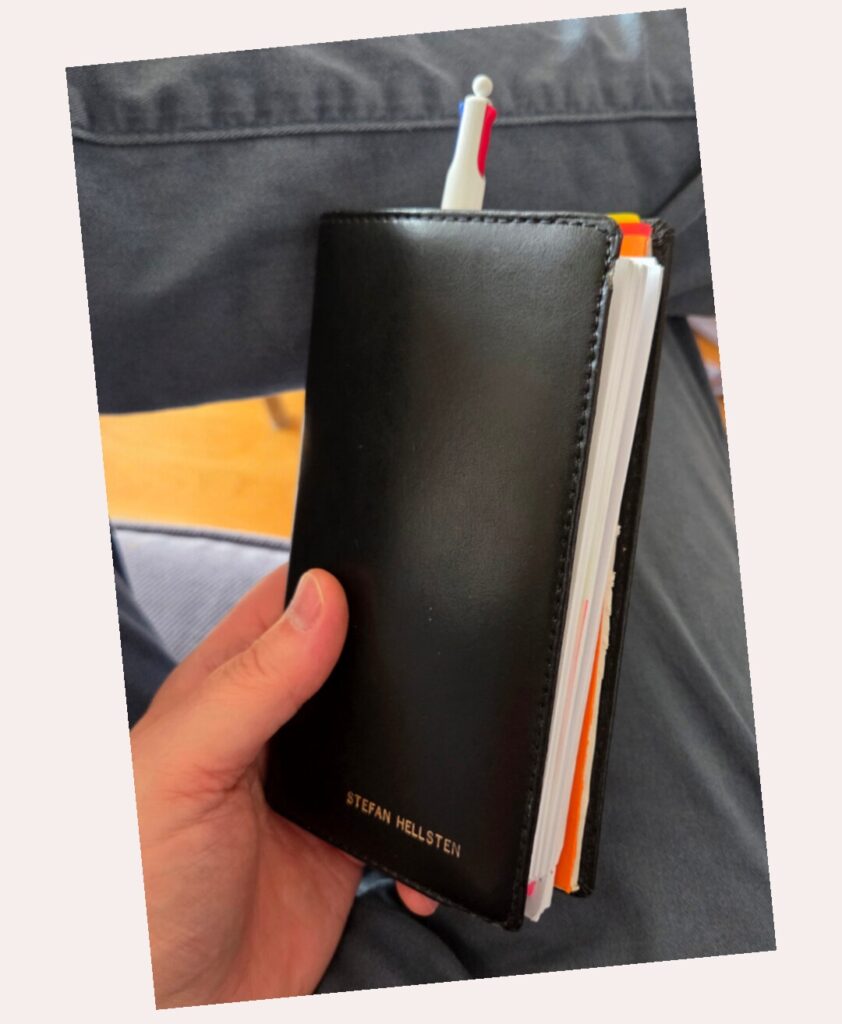
Däremot påminns jag om alla gånger jag bestämt mig för att byta ut den gamla papperskalendern mot en digital variant i mobilen. Google Calendar eller liknande. Fördelarna tycks så uppenbara! Säkerhetskopiering uppe i “molnet”. Åtkomligt från alla devices! Dock brukar det bara gå dagar, en vecka max, innan jag är less på det själsdödande pickandet i menyer och rullgardiner och letar fram den vanliga kalendern igen.
Och lovar mig själv att aldrig göra om samma misstag.
Relevans för denna blogg? När jag läste inlägget på sociala medier föreföll resultatet av experimentet ha “face value”, som det heter. Dvs kändes sant, avslöjande och rimmade så bra med en allmän – och motiverad – skepsis mot teknifieringen av vår vardag, AI, sociala medier, mm. Mindfulness. “Back to the nature”, liksom.
Men kanske kan gå för långt åt det hållet med?
Jag roade mig med att klippa ut de mera emotionella bitarna ur det där inlägget jag först läste
A Norwegian neuroscientist spent 20 years proving that the act of writing by hand changes the human brain in ways typing physically cannot, and almost nobody outside her field has read the paper. […]
The finding is brutal enough that it should have changed every classroom on Earth. […]
Your fingers, wrist, vision, and the parts of your brain that track position in space are all working together to produce one letter, then the next, then the next. Typing throws all of that away. […]
Pressing the same key with the same finger over and over does not stimulate the brain in any meaningful way, and she pointed out something that should scare every parent who handed their kid an iPad. […]
Children who learn to read and write on tablets often cannot tell letters like b and d apart, because they have never physically felt with their bodies what it takes to actually produce those letters on a page. […]
Handwriting makes the brain work. Typing lets it coast. […]
Every note you have ever typed instead of written went into your brain through a thinner pipe. Every meeting, every book highlight, every idea you captured on your phone instead of on paper was processed at half depth.
You did not forget those things because your memory is bad. You forgot them because typing never woke the part of the brain that would have made them stick.
The fix is the thing your grandmother already knew. Pick up a pen. Write the thing down. The slower road is the faster one.
Jag har en känsla av att kritikerna har rätt ändå.
Förmodligen är det någon skillnad, att det som skrivs för hand är mer sensuellt, etc, och aktiverar något fler centra i hjärnan. Men för den vuxne som får använda sitt tangentbord som den är van, jämfört med att skriva samma text för hand, tror jag inte skillnaden – och markörerna i hjärnan – blir så markant annorlunda som studien kan locka en att tro.
Bild: Luis Quintero/Unsplash